
Building automation systems is exciting. You can connect platforms, eliminate repetitive tasks, and design workflows that run without human intervention around the clock. But at some point, a critical question surfaces—one that every stakeholder, business owner, or client will inevitably ask: “Is this actually worth the investment?”
That question is at the heart of this article. Understanding the return on investment of automation is not just an academic exercise. It is the skill that separates someone who tinkers with workflows from someone who builds systems that transform businesses. Whether you are automating processes within your own organization or pitching your services to an external client, your ability to identify, measure, and articulate the financial value of automation will determine how seriously people take your work.
There is a unique challenge embedded in the automation space, though. Unlike a paid advertising campaign, where you can point to a clear revenue figure—spend five thousand dollars on ads and generate thirty thousand in sales—automation operates more quietly. It works behind the scenes. It saves minutes here, eliminates an error there, and frees up a team member to focus on something more important. The value is real, but it can feel invisible if you do not know how to measure and communicate it.
By the end of this article, you will know exactly how to pinpoint the processes that yield the highest returns, quantify the time and money your automations save, and present that value in a way that resonates with decision-makers.
Why Automation ROI Can Be Difficult to Perceive
Before diving into formulas and frameworks, it is worth understanding why so many people struggle to see the value of automation in the first place. The root cause comes down to two psychological tendencies that affect how humans evaluate tools and investments.
The Visibility Problem
People tend to assign value to things based on how frequently and directly they interact with them. If you pay for a software subscription and open it every single day, it feels valuable. If you pay for a tool you rarely touch, you start questioning whether it is worth the cost—even if that tool is quietly doing its job in the background.
Automation falls squarely into this trap. A well-designed automated workflow is one you rarely think about. It triggers itself, processes data, routes information, handles exceptions, and delivers results without requiring your attention. Paradoxically, the better an automation works, the less visible it becomes. And that invisibility can lead people to underestimate its worth.
Consider something as simple as an automated invoice processing system. Once it is running, invoices arrive, get parsed, matched to purchase orders, and logged into your accounting platform without anyone lifting a finger. After a few weeks, the team forgets how painful the old manual process was. The automation fades into the background, and suddenly, the monthly cost of maintaining it starts to feel like an expense rather than a savings.
The Time-Versus-Money Perception Gap
The second challenge is that most people think in terms of money, not time. When a business owner evaluates an investment, they want to know how many additional dollars it will generate. Automation, however, primarily saves time. And while saved time absolutely translates into financial value, that translation requires an extra mental step that many people do not naturally make.
Imagine telling a client, “Our system will save your team about eight hours every week.” That sounds useful, but it does not hit the same way as, “Our system will put an extra four thousand dollars back into your budget every month.” Both statements might describe the same outcome, but the second one speaks the language that decision-makers respond to. A major part of your job when building and selling automation is learning to bridge that gap—taking time savings and converting them into dollar figures that resonate.
There is also a compounding effect that people tend to overlook. Saving someone an hour each day might not feel dramatic on any given Tuesday. But after a month, that is roughly twenty hours recovered. After a year, it is over two hundred hours—the equivalent of more than five full work weeks. And once someone has grown accustomed to that recovered time, taking the automation away would feel devastating. Think about how integrated AI assistants have become in everyday work. If every large language model disappeared overnight, you would instantly feel the weight of every email, brainstorm, and draft you now handle with their help. Automation creates the same kind of dependency, and that dependency is a clear indicator of value.
Understanding Return on Investment
At its core, return on investment is a straightforward financial concept. It measures how much profit or benefit you receive relative to what you spent. The standard formula is simple:
ROI = (Net Return ÷ Cost of Investment) × 100
In the context of automation, the “net return” encompasses all the financial benefits your automated system delivers—labor cost reductions, error savings, productivity gains, and revenue generated from reallocated time. The “cost of investment” includes everything you spend building and maintaining the system: development time, platform subscriptions, hosting fees, and ongoing support.
This formula gives you a percentage that tells a clear story. An ROI of 200% means that for every dollar invested, you received two dollars back in value. An ROI of 50% means you earned back your investment plus half again. The higher the number, the stronger the case for the automation.
What makes this formula particularly powerful in the automation context is that costs tend to be front-loaded while returns accumulate over time. You spend money upfront to design and deploy the system, but once it is running, the savings compound week after week, month after month. This means that ROI often starts modest and then accelerates—a pattern that works heavily in your favor when you track it properly.
Tangible Versus Intangible Benefits
When building a case for automation, you will encounter two broad categories of value. Understanding the distinction between them will help you construct a more complete and persuasive argument.
Tangible Benefits
These are the outcomes you can directly measure with numbers. They form the backbone of any ROI calculation because they are concrete and defensible. The primary tangible benefits of automation include time savings (the hours your team no longer spends on manual execution), cost reductions (lower labor expenses, fewer software subscriptions, reduced overhead), and improved compliance (fewer regulatory violations, better record-keeping, and more consistent process adherence).
Tangible benefits are where you should start any ROI conversation. They give you hard data to work with, and they are difficult for skeptics to dismiss. When you tell a stakeholder that your system eliminated fifteen hours of manual data entry per week at a labor cost of forty dollars per hour, that is a clear, quantifiable saving of six hundred dollars weekly—or over thirty thousand dollars annually.
Intangible Benefits
These are the outcomes that matter enormously but resist precise measurement. They include improvements in employee morale and satisfaction (because people are no longer stuck doing tedious, repetitive work), enhanced customer experience (because faster processing means quicker responses and better service), and stronger decision-making (because automated data collection gives leaders cleaner, more timely information to act on).
While intangible benefits should not be the centerpiece of your initial pitch, they absolutely deserve a place in the conversation. Over the long term, these softer benefits often drive some of the most meaningful organizational improvements. A team that is freed from monotonous work tends to be more engaged, more creative, and less likely to burn out.
Identifying High-ROI Processes
Not every process is equally suited for automation, and not every automation delivers the same return. Knowing which workflows to target first is one of the most important strategic decisions you will make. The processes that tend to yield the highest returns share five key characteristics.
Repetitive and rule-based processes follow a consistent, predictable pattern every time they run. There is little judgment or creative thinking required—just a set of steps that unfold the same way each cycle. Payroll calculations, order confirmations, and status update notifications all fit this description.
High-volume processes occur frequently—multiple times per day, dozens of times per week, or hundreds of times per month. The more often a process runs, the more time each small improvement saves in aggregate.
Time-intensive processes consume significant chunks of your team’s working hours. Even if a process only happens once a week, it is a strong automation candidate if each instance takes three hours of manual effort.
Error-prone processes are those where human mistakes happen regularly and carry real consequences. Data entry across systems, manual calculations, and copy-paste workflows are notorious for introducing errors that cost time and money to fix.
Cross-system processes require moving information between different platforms—pulling data from one application, transforming it, and pushing it into another. These workflows are tedious for humans but perfectly suited for automation tools that can connect to multiple APIs simultaneously.
When you find a process that exhibits several of these traits at once, you have likely found a high-ROI automation opportunity.
Five Essential Questions for Evaluating Any Process
Before committing time and resources to automating a particular workflow, you need to gather some critical data points. Whether you are evaluating your own internal operations or conducting discovery with a client, these five questions will form the foundation of your ROI analysis.
How frequently does this process occur? Is it something that happens multiple times daily, once per day, weekly, or monthly? Frequency is one of the strongest multipliers of automation value. A task that saves five minutes but runs fifty times per day delivers far more value than one that saves an hour but only happens once a month.
How long does each execution take? Measure the total manual time required to complete the process from start to finish. Include every step—data gathering, processing, verification, communication, and documentation.
How many people are involved? Processes that require multiple team members to coordinate represent not just direct labor costs but also communication overhead, scheduling challenges, and handoff delays.
What is the hourly cost of the labor involved? Knowing the labor cost of the employees performing the work allows you to convert time savings directly into dollar amounts.
What is the current error rate, and what does each error cost? Errors create cascading expenses—time spent identifying the mistake, correcting it, communicating about it, and sometimes compensating affected parties. Even a modest error rate can represent a substantial hidden cost.
Armed with answers to these five questions, you can construct a clear before-and-after picture that demonstrates exactly how much value your automation delivers.
Suppose you are evaluating a daily order processing workflow for a mid-sized e-commerce company. Through your discovery process, you learn the following: the process runs every business day, each execution takes about twenty minutes of manual effort, four team members are involved, each earning approximately fifty dollars per hour, and errors occur roughly twice per month at a cost of one hundred dollars each.
With these numbers in hand, you can project that your automated system will reduce the processing time from twenty minutes to roughly two minutes, eliminate the need for any team members to be directly involved, and include built-in validation checks that virtually eliminate errors. That represents a dramatic shift in both cost and efficiency, and the numbers make the case far more persuasively than any abstract promise ever could.
Quantifying Time Savings and Revenue Impact
One of the most effective ways to demonstrate automation value is through rigorous time-savings calculations. The process is straightforward, and the results are often eye-opening.
Calculating Time Savings
Start by measuring how long the current manual process takes. Then estimate how long the automated version will take. The difference between these two figures is your time savings per execution. Multiply that by the number of times the process runs in a given period, and you have your total time recovered.
For example, imagine a weekly reporting process that currently takes sixty minutes of manual work. After automation, the system handles everything in about twenty minutes (including data pulls, formatting, and distribution), requiring only a quick five-minute review from a team member. That gives you thirty-five minutes saved per execution. If this report runs twenty times per month across different departments, you are recovering nearly twelve hours of labor every month.
Translating Time Into Financial Value
Recovered time has financial value in two distinct ways. The first and most straightforward is cost reduction. Every hour your team no longer spends on a manual task is an hour of labor you are no longer paying for. You can calculate this by multiplying the hours saved by the fully loaded hourly cost of the employees involved.
The second, often more significant, impact is revenue generation through reallocation. When your team members are freed from repetitive work, they can redirect their energy toward activities that directly drive growth—conducting more sales conversations, developing new marketing campaigns, improving customer relationships, or building new products. The value of this reallocation can far exceed the raw labor cost savings.
One important detail that many people overlook when performing these calculations is the true cost of an employee. The base salary or hourly wage is only part of the picture. When you factor in benefits, health insurance, payroll taxes, compliance costs, training expenses, and management overhead, the actual cost of an employee can be 25 to 50 percent higher than their base compensation. In the United States, research suggests the average total burden adds approximately 43 percent on top of base wages. Using the fully loaded cost in your calculations gives you a more accurate and often more compelling picture of the savings.
Key Factors That Influence Automation ROI
Several variables determine how quickly and dramatically your automation investment pays off. Understanding these factors helps you set realistic expectations and choose your projects wisely.
Process Complexity and Volume
Workflows that are both high in volume and moderate to high in complexity tend to deliver the greatest long-term returns. A complex, high-frequency process that previously required significant manual oversight becomes enormously valuable once automated. However, these are typically not the best starting points for your first project. The ideal entry point is a process that is high-volume but relatively simple—giving you a quick win that builds confidence and demonstrates value before you tackle more ambitious targets.
Initial Investment
The amount you spend upfront on designing, building, and deploying the automation directly affects how long it takes to reach positive ROI. Larger investments naturally require a longer payback period. The encouraging reality of modern low-code and no-code automation platforms is that they have drastically reduced the upfront cost of building sophisticated workflows. Systems that would have previously required a full development team working for months can now be assembled by a single skilled builder in a matter of days, at a fraction of the cost.
Operational Schedule
How often your automation runs has a dramatic impact on payback timing. Industry research indicates that a process running during a single business shift five days a week might take over three years to achieve full ROI, while the same process running continuously around the clock can reach payback in less than a year. That is roughly a four-to-one difference. This makes intuitive sense—an automation that works twenty-four hours a day, seven days a week captures value during every hour that a human team would otherwise need to be paid for.
True Labor Costs
As discussed earlier, the real cost of human labor extends well beyond base pay. When building your ROI models, always account for the full spectrum of employment costs: base wages, benefits and insurance, payroll taxes and compliance expenses, training and onboarding costs, and management oversight. Incorporating these factors can increase the apparent cost of the labor your automation replaces by 25 to 50 percent—which correspondingly strengthens your ROI case.
Five Comprehensive Metrics for Measuring Automation ROI
While the basic ROI formula gives you a single percentage figure, a more thorough evaluation examines five distinct dimensions of value. Tracking all five provides a richer, more defensible picture of what your automation delivers.
1. Cost Savings
This is the most direct metric. It captures reduced labor expenses, lower error remediation costs, decreased training and infrastructure spending, and savings on software subscriptions that are no longer needed. Cost savings are the easiest to quantify and the hardest for stakeholders to argue against.
2. Productivity Gains
Automation typically enables faster task completion, higher output volumes within the same time frame, improved accuracy across every execution, and the ability to absorb peak workloads without needing to hire additional staff. Productivity gains demonstrate that your team can accomplish more without spending more.
3. Revenue Growth
When automation frees up your team’s time, that time can flow into revenue-generating activities. Faster service delivery leads to higher customer satisfaction and retention. Freed capacity enables your organization to take on more clients, launch new products, or scale operations without proportionally scaling headcount.
4. Efficiency Improvements
This metric looks at how automation streamlines the overall flow of work. It captures shorter cycle times from start to finish, more effective utilization of team resources, and the elimination of bottlenecks that previously caused delays and frustration.
5. Compliance and Risk Management
Automated systems follow their instructions exactly, every time. This consistency reduces regulatory violations and associated penalties, improves audit readiness with complete documentation trails, minimizes human error in sensitive processes, and strengthens data security through controlled, predictable handling.
The Four-Step ROI Calculation Process
Measuring automation ROI is not a one-time event. It is an ongoing practice that should evolve as your systems mature. The following four-step framework gives you a structured approach to tracking value over time.
Step 1: Define Your Objectives and Key Performance Indicators
Before you build anything, get crystal clear on what you are trying to achieve. Which specific process are you automating? What measurable outcomes do you expect? And what key performance indicators will you track to determine success? Your KPIs might include metrics like average processing time, error rate, throughput volume, customer response time, or any other quantifiable measure that reflects the health and efficiency of the process.
Step 2: Establish Baseline Measurements
You cannot demonstrate improvement without knowing where you started. Before deploying your automation, gather detailed data on the current state of affairs: how much time the manual process consumes, how frequently errors occur, what resources are being used, and what the current throughput looks like. This baseline becomes the benchmark against which you measure every future gain.
Step 3: Deploy and Monitor
Once your automation is live, track those same KPIs consistently. Document not just the raw numbers but also any unexpected outcomes—both positive and negative. Compare your actual results against your initial projections. If possible, run the automated and manual processes in parallel for a brief period so you can generate a direct side-by-side comparison.
Step 4: Calculate ROI Across Multiple Time Horizons
Rather than computing a single ROI number, evaluate your returns at three intervals: short-term (three to six months), medium-term (twelve months), and long-term (two years and beyond). This multi-horizon approach reveals an important pattern. If you have selected the right processes and your systems are functioning properly, your ROI should not grow at a steady, linear rate. It should accelerate. The returns compound as the automation handles increasing volumes, as your team grows more comfortable reallocating their freed time, and as the organization scales. This exponential growth pattern is one of the most compelling arguments you can make for continued investment in automation.
Automation ROI in the Real World
Theoretical frameworks are valuable, but concrete examples bring the concepts to life. Consider how organizations across different industries have realized measurable returns from their automation investments.
In the financial services sector, major institutions have deployed AI-powered chatbots and automated customer service workflows that have slashed operational costs by significant margins while simultaneously improving customer satisfaction scores and enabling round-the-clock availability. The combination of cost reduction and improved service quality creates a powerful dual benefit that few traditional investments can match.
In manufacturing, companies have implemented automated quality control, predictive maintenance, and production scheduling systems that have meaningfully reduced production timelines, lowered operational costs, and pushed on-time delivery rates to near-perfect levels. When a single automation initiative can improve speed, reduce cost, and increase reliability all at once, the ROI case essentially makes itself.
In consumer goods and logistics, automation has optimized inventory management, demand forecasting, and supply chain coordination—driving down inventory carrying costs, minimizing stockouts, and streamlining distribution. These are processes that touch every part of the business, which means the ripple effects of even modest improvements can be enormous.
One particularly striking example from the warehouse automation space involved a facility that transitioned from manual operations to robotic process handling. The result was a shift from requiring thirty-five workers per shift to just two—while simultaneously expanding from two operational shifts to three. The labor savings alone were staggering, but the ability to scale capacity at the same time made the investment transformative.
The Low-Code Advantage
One of the reasons automation ROI has become so accessible in recent years is the rise of low-code and no-code development platforms. These tools have fundamentally changed the economics of building automated systems.
Faster, more affordable development means your upfront investment is lower, which shortens your path to positive ROI. Projects that might have taken a software engineering team weeks or months can now be completed by a single builder in days.
Flexible, adaptable workflows allow you to modify and iterate on your automations as business needs evolve, without starting from scratch. This adaptability protects your investment and ensures your systems stay relevant.
Scalable architecture means your automations can grow alongside your business. As transaction volumes increase or new processes come online, the system expands without requiring a proportional increase in cost.
Self-hosting options give you greater control over your data and reduce ongoing subscription expenses, which further improves your long-term ROI.
Using an Impact-Complexity Matrix to Prioritize
When you are staring at a list of ten or fifteen processes that could potentially be automated, you need a clear framework for deciding which one to tackle first. The impact-complexity matrix is one of the most practical tools for making that decision.
Picture a simple two-by-two grid. The vertical axis represents impact—how much value the automation would deliver. The horizontal axis represents complexity—how difficult and resource-intensive it would be to build. This creates four quadrants, each with a different strategic implication.
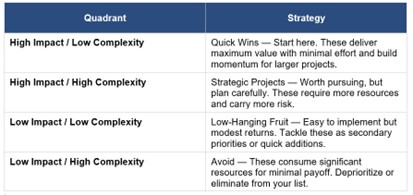
The sweet spot—the place where you should nearly always begin—is the high-impact, low-complexity quadrant. Projects in this zone deliver meaningful results quickly, require relatively modest investment, and create the proof of concept you need to justify larger, more ambitious automation initiatives down the road.
Choosing Your First High-ROI Automation
If you are just getting started or advising someone who is, here are the guiding principles that will set you up for success.
Begin with something small but meaningful. Your first automation does not need to overhaul an entire department. It needs to deliver a clear, visible win that makes people sit up and pay attention. A single workflow that saves a team two hours every day is more than enough to demonstrate the power of what you are building.
Prioritize frequency over rarity. A process that runs dozens of times per week will almost always deliver more cumulative value than one that happens infrequently, even if the rare process is more complex or time-consuming per instance.
Account for every dimension of ROI. Do not limit your calculations to time savings alone. Factor in error reduction, opportunity cost of reallocated labor, potential for scaling, and the intangible benefits of improved morale and customer experience.
Measure before and after. Establishing clear baseline metrics and tracking post-implementation results is not optional. It is the evidence that proves your system works and justifies future investments.
Adopt a long-term mindset. The true value of automation reveals itself over months and years, not days. Early returns are often just the beginning. As the system matures, as your team adapts, and as the business grows, the compounding effects become increasingly powerful.
Bringing It All Together
The ability to identify, measure, and communicate automation ROI is one of the most valuable skills you can develop in this field. It elevates your work from a technical exercise to a strategic business function. It gives you the language to speak confidently with executives, business owners, and clients. And it ensures that every system you build is grounded in genuine, demonstrable value.
Remember that the challenge is rarely the automation itself. The real challenge is helping people see the value of something that operates quietly in the background. By grounding your conversations in concrete numbers—time saved, costs reduced, errors eliminated, revenue unlocked—you cut through the perception gap and make the invisible visible.
Start with the processes that offer the highest impact for the least complexity. Gather your baseline data. Build, deploy, and track. Calculate your returns over progressively longer time horizons and watch the compounding effect take hold. That is the path from a single workflow to a portfolio of automations that fundamentally transforms how a business operates.